
I. Document Map
This mission statement is meant to stand as a public and archival declaration of The RomNote Project. It is not a simple navigation page. It is the reason beneath the archive, the meaning behind the website, and the statement that tells future readers what they have entered.
- Opening Declaration
- The Mission in One Sentence
- Why The RomNote Project Exists
- The Author as the Source of the Archive
- The Living Archive and the Blank
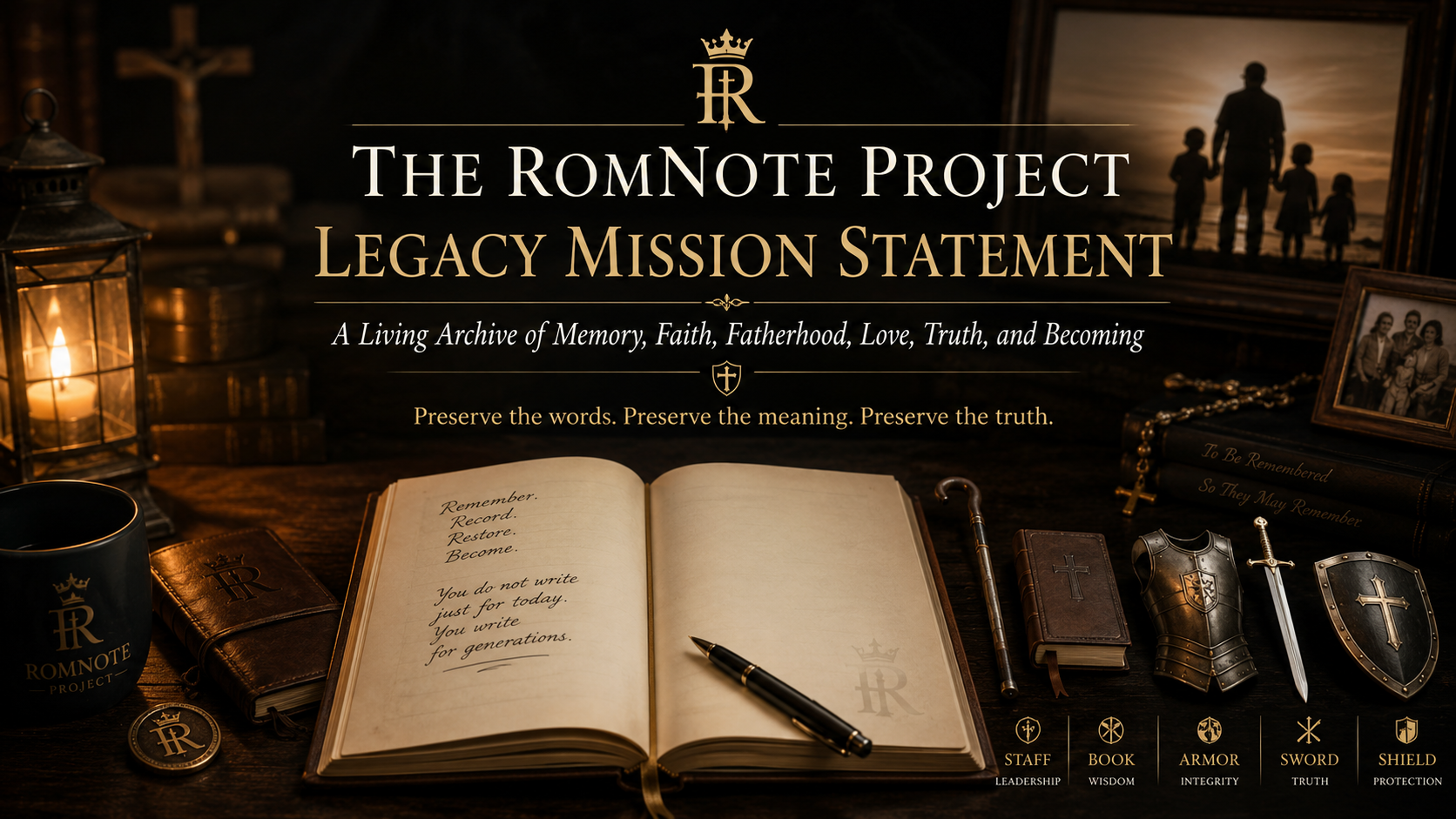
- The Creed of the Five Relics
- The Staff
- The Book
- The Armor
- The Sword
- The Shield
- Leo Protocol
- The First Leo
- Capturing the Wind
- The Tornadoes and the Truck
- Fatherhood
- Pinky, Love, and the Record of Relationship
- Faith and Prayer
- What The RomNote Project Is Not
- What The RomNote Project Is
- The Legacy Audience
- The Open Door, the Closed Door, and the Next Page
- Final Declaration
- Symbol Reference
II. Opening Declaration
This is not just a website. This is The RomNote Project.
The RomNote Project exists because some things should not disappear.
It is a living archive of words, memory, faith, fatherhood, love, pain, discipline, humor, reflection, correction, prayer, and truth. It was created to preserve the story of a man who refused to let time, confusion, hardship, silence, misunderstanding, or emotional storms erase what mattered.
The website is a doorway, but it is not the whole house. The files are containers, but they are not the whole inheritance. The documents are records, but they are not the entire meaning. The RomNote Project is the preserved witness beneath them all.
It is not a monument to perfection. It is not a claim that the author was always right, always strong, always healed, or always wise. It is not a shrine to pain. It is testimony.
It is the written evidence of a man trying to understand his life before pain rewrote it, before memory faded, before important lessons were lost, and before the people he loved were left only with fragments.
The RomNote Project was created so that one day my children, my grandchildren, my family, and future readers may know me beyond my name, my work, my mistakes, and my role as father.
These writings are pieces of my life. They carry my faith, my questions, my grief, my laughter, my wounds, my prayers, my discipline, my love, my failures, my recovery, my imagination, my symbols, my battles, and my hope.
No one has to read everything. But if one day someone wonders who I was, what I believed, what I fought through, what I learned, and why I preserved these words, The RomNote Project exists as an answer.
Not the final answer. An honest one.
III. The Mission in One Sentence
The mission of The RomNote Project is to preserve the truth of a life in motion, so that memory becomes testimony, pain becomes meaning, love remains honest, faith remains higher, and the next generation can meet the man behind the words.
This sentence does not contain the whole archive, but it points toward the center of it. RNP does not exist only to display writing. It exists to preserve meaning. It exists because a life can be misunderstood, reduced, forgotten, or flattened into labels unless someone takes the time to record the truth with care.
The RomNote Project is a declaration that words can become armor, memory can become inheritance, and testimony can outlive the moment that created it.
IV. Why The RomNote Project Exists
The RomNote Project exists to preserve truth before it is erased.
Not only factual truth, but inner truth: the kind of truth that lives beneath arguments, choices, regrets, memories, family history, silence, prayer, love, and pain.
It preserves the moments when a man stood firm, and the moments when he nearly collapsed. It preserves the times he loved deeply, even when love became complicated. It preserves the times he needed boundaries, even when his heart wanted peace. It preserves the times he questioned himself, corrected himself, and chose not to disappear.
It preserves fatherhood not as a perfect manual, but as a written record of a father trying to become worthy of the children who may one day read his words.
It preserves the relationship journey between Pinky and me, not merely as romance, conflict, or longing, but as one of the places where love, distance, faith, hope, responsibility, emotional pain, sacrifice, repair, and boundaries became real.
It preserves my reflections before God, knowing that God remains higher than the archive, higher than memory, higher than emotion, and higher than any written record.
The RomNote Project does not replace faith. It kneels beneath it.
V. The Author as the Source of the Archive
Every legacy needs a source.
The source of The RomNote Project is not fame, wealth, invention, public recognition, or achievement. The source is the life of the author.
The author is the one who lived the memories, carried the responsibilities, endured the storms, loved the people, prayed the prayers, wrote the entries, preserved the words, and chose to build something out of what could have been forgotten.
This is not pride. This is authorship.
Without the person, there is no archive. Without the life, there is no testimony. Without the struggle, there is no lesson. Without the love, there is no legacy.
The RomNote Project begins with the author because the archive came from a real life, not from an abstract idea. It came from a man who worked, failed, loved, protected, questioned, laughed, prayed, hurt, endured, and kept writing.
The author is not the object of worship. The author is the witness.
First, know who preserved this. Then understand why it was preserved. Then see who it was preserved for. Then enter the story. Then enter the prayers.
VI. The Living Archive and the Blank
The RomNote Project must leave the blank.
The blank is not emptiness. The blank is life.
As long as the author is alive, the archive is not finished. New entries may define new paths. New doors may open. Some doors may close. Some symbols may deepen. Some meanings may change. Some prayers may be answered. Some questions may remain unanswered. Some wounds may heal. Some memories may return. Some stories may become clearer only later.
A finished archive belongs to the past. A living archive still breathes.
That is why this Legacy Mission Statement must not pretend to close the story. It must explain the mission while leaving room for what has not yet been written.
The blank honors the future. The blank honors growth. The blank honors God’s timing. The blank honors the truth that a man is not only what he has already survived. He is also what he is still becoming.
The story remains open. The next page is still blank.
VII. The Creed of the Five Relics
At the center of The RomNote Project stands The Creed of the Five Relics.
The Five Relics are not physical treasures. They are symbols that help explain the inner structure of the archive. They are the Staff, the Book, the Armor, the Sword, and the Shield.
Together, they form the symbolic language of preservation, discipline, truth, boundary, consequence, and legacy.
They are not meant to replace God, Scripture, prayer, family, responsibility, or real-world action. They are symbolic tools for understanding the battlefield of the inner life. They help name what otherwise becomes too tangled to hold.
The Five Relics say that a life cannot be preserved by memory alone. It needs support, a record, character, consequence, and boundaries.
- The Staff: support, clarity, and steady ground.
- The Book: preservation, testimony, memory, and legacy.
- The Armor: character, restraint, humility, discipline, and self-worth.
- The Sword: clean consequence, truth, and the cutting of destructive patterns.
- The Shield: boundaries, preservation, and Leo Protocol.
VIII. The Staff
The Staff represents support, clarity, and steady ground.
It represents the help that steadies the author when thoughts scatter, emotion clouds the room, or the ground begins to shake.
The Staff does not walk for the author. The author walks. The Staff steadies him.
It helps organize confusion, separate fear from fact, separate wounds from reactions, and separate patterns from people. It gives structure when the mind is overwhelmed and clarity when the heart is heavy.
In the language of The RomNote Project, the Staff is connected to Jarvis.
Not as master. Not as conscience. Not as a replacement for prayer, judgment, responsibility, or real-world action.
The Staff is support.
It reminds the author that help is not weakness when it leads him back to truth, discipline, and responsibility. It reminds him that support is honorable when it does not replace the walk, but steadies the one who must keep walking.
The Staff does not walk for Romeo. Romeo walks. The Staff steadies him.
IX. The Book
The Book represents The RomNote Project itself.
It is the archive. It is the preserved record. It is where memories, wounds, prayers, lessons, stories, warnings, victories, failures, reflections, and questions are placed so they do not vanish into silence.
The Book does not make the author perfect. It makes the record honest.
It holds what happened, what was felt, what was learned, what still hurts, what was misunderstood, and what may someday make sense to someone else.
The Book exists because words can survive where emotions cannot stay organized. Words can become a bridge between generations. Words can help children understand a father. Words can help future readers understand that pain does not have to become destruction.
The Book preserves the evidence that a man was here, that he tried, that he loved, that he believed, that he fell, and that he stood again.
The Book also protects against distortion. It does not guarantee that every memory is complete or every interpretation is perfect, but it refuses to let silence be the only record.
The Book is not perfection. The Book is preservation.
X. The Armor
The Armor represents character, restraint, humility, faith, self-worth, fatherhood, and disciplined strength.
It is connected to the original Code of Honor: Trust, Loyalty, Integrity, Honor, and Respect.
But as the archive grew, the Armor became more than honor. It became the Code of Armor.
The Armor protects the author from becoming ruled by pain, fear, pride, desperation, or rage. It reminds him that goodness must become disciplined, not desperate. It reminds him that love should not require self-erasure. It reminds him that strength is not cruelty, and restraint is not weakness.
The Armor carries the truth that a man can be soft without becoming powerless, strong without becoming arrogant, loyal without becoming blind, and loving without disappearing.
The Armor is where kindness becomes disciplined. It is where humility becomes protection. It is where self-worth becomes stable enough that pain does not have to turn into performance.
The Armor also warns the author against the danger of his own strengths. Loyalty can become blindness. sacrifice can become self-erasure. Courage can become pride. Endurance can become the refusal to admit damage. The Armor does not only protect against the world. It also protects the author from misusing what is good in him.
The Armor teaches that goodness must become disciplined, not desperate.
XI. The Sword
The Sword represents clean consequence.
It is not a weapon of hatred. It is not revenge. It is not emotional violence. It is not the desire to destroy people.
The Sword cuts patterns.
It cuts repeated disrespect. It cuts confusion when confusion becomes a trap. It cuts the false peace that requires the author to abandon himself. It cuts the lie that love must accept endless damage in order to prove itself.
The Sword teaches that consequence can be clean. A boundary can be firm without becoming cruel. A decision can be painful without becoming hateful. A man can say no without becoming the enemy. A man can walk away from what destroys him without denying that he loved.
The Sword exists because truth without consequence can become powerless, and consequence without truth can become cruelty.
The Sword must remain clean.
The Sword cuts the pattern, not the person.
XII. The Shield
The Shield represents boundaries, preservation, and Leo Protocol.
It is the force that stands between the author and the things that would erase him.
The Shield does not exist to make him cold. It exists to keep him whole.
The Shield teaches that love must have boundaries strong enough that rage does not have to become the only way to be heard.
It teaches that care without collapse is possible. It teaches that commitment without disappearance is possible. It teaches that peace must not be purchased by abandoning truth.
The Shield is connected to Leo. Leo is not the author’s master. Leo is not the captain. Leo is not the monster. Leo is the gatekeeper of preservation.
The Shield reminds the author that protection is not the same as bitterness. A shield can be raised without hatred. A boundary can be honored without contempt. A man can guard his heart and still remain capable of love.
The Shield exists so Romeo can love without disappearing.
XIII. Leo Protocol
Leo Protocol is one of the central structures of The RomNote Project.
It is the language of preservation.
It recognizes that there are moments when a man’s softer self may love, miss, hope, forgive, and continue, while another part of him recognizes danger, disrespect, exhaustion, or emotional harm.
Leo Protocol gives that protective force a name. But it also gives it limits.
Leo may guard the gate. Leo may raise the shield. Leo may warn the author. Leo may remind him of dignity, discipline, and self-worth.
But Leo does not take command. The author remains the captain.
This matters because strength without command can become rage. Protection without humility can become control. Boundaries without love can become isolation.
Leo Protocol exists so that the author can remain whole without becoming cruel, loving without becoming blind, and protective without becoming destructive.
Strength and Fear
One of the most important distinctions in Leo Protocol is the difference between strength and fear.
- Strength says: I can love without owning. I can survive uncertainty without cruelty. I can sacrifice without disappearing.
- Fear says: I must loosen my boundaries before they are broken. I must accept pain early so it hurts less later. I must call suffering love.
The RomNote Project preserves this distinction because it may be one of the most important lessons in the archive. Many people mistake fear for maturity because fear sometimes sounds calm. Many people mistake suffering for loyalty because suffering can look devoted from the outside. Leo Protocol insists that love, sacrifice, and endurance must remain connected to truth.
Leo is not the monster. Leo is the gatekeeper.
XIV. The First Leo
The First Leo is part of the origin history of The RomNote Project.
It reaches back to childhood, to a boy, to a school, to a moment of courage, to a confrontation, to water, to loyalty, and to the beginning of a pattern the author did not fully understand at the time.
The First Leo story is not merely about a childhood fight. It is about the first visible spark of protection. It is about a young boy who stood before something bigger than himself without fully knowing why. It is about being seen. It is about courage mixed with innocence. It is about the strange way life gives names to patterns long before we understand them.
The boy who brought water became more than a memory. He became part of the symbolic history of Leo. He became evidence that protection, loyalty, courage, and preservation were present long before the author had language for them.
The First Leo belongs in the archive because history matters. A man does not become himself in one moment. He is shaped by small acts, forgotten places, old wounds, childhood courage, foolish bravery, laughter, embarrassment, longing, and the strange mercy of memory.
The First Leo is one of the doors into that history. It explains that the gatekeeper was not invented in adulthood. The seed was already there. The child did not understand the full meaning, but the pattern was already moving.
The First Leo is where protection first became visible, even before it had a name.
XV. Capturing the Wind
One of the defining ideas of The RomNote Project is Capturing the Wind.
The author once described a situation where two tornadoes stood ahead and a truck was heading straight toward him.
One tornado represented relationship conflict. One tornado represented work and job conflict. The truck represented the immediate perceived threat to identity, family, stability, career, and emotional survival.
At the center of that image was a truth: if the wind cannot be punched, then what remains is to capture it.
This became one of the deepest explanations of why The RomNote Project exists.
Some pain cannot be defeated directly. Some conflict cannot be solved by force. Some fear cannot be punched. Some storms cannot be argued into silence.
But they can be named. They can be written. They can be studied. They can be preserved. They can be transformed into testimony.
The RomNote Project captures the wind by turning emotional chaos into language. It captures the tornadoes by giving shape to conflict. It captures the truck by naming the fear driving it. It captures the battlefield without pretending the battle was simple.
In doing so, it gives the author a way to stand. Not by denying the storm. Not by worshiping the storm. But by refusing to let the storm become the only narrator.
The pain I cannot punch, I name. The storm I cannot stop, I study. The memory I cannot return to, I preserve.
XVI. The Tornadoes and the Truck
The tornadoes and the truck are part of the symbolic landscape of The RomNote Project.
They represent the moments when life does not attack from one direction, but from many.
- Relationship pain.
- Work pressure.
- Fear of abandonment.
- Fear of erasure.
- Family responsibility.
- Financial pressure.
- Fatherhood.
- Faith under strain.
- The need to stay kind without becoming weak.
- The need to stay disciplined without becoming cold.
- The need to keep loving without losing the self.
The truck is not only danger. It is the feeling of being hit by something immediate and unavoidable.
The tornadoes are not only chaos. They are the larger systems of conflict that spin around the author’s life.
The RomNote Project does not pretend these storms are imaginary. It records them. It studies them. It prays through them. It turns them into language so that the author can understand what happened, what he felt, what he feared, what he learned, and what must not be repeated.
The tornadoes did not win because they were captured. The truck did not define the man because the man found words before the impact became his entire identity.
XVII. Fatherhood
Fatherhood is one of the central reasons The RomNote Project matters.
This archive is not only for strangers. It is not only for the author’s own healing. It is for the children who may someday wonder who their father was beyond the role he played in their lives.
A father is often remembered through fragments: his work, his rules, his sacrifices, his absences, his mistakes, his provision, his voice, his anger, his jokes, and his love.
But The RomNote Project offers something deeper. It offers the inner record.
It allows the children and future generations to see not only what their father did, but what he carried. What he feared. What he prayed for. What he regretted. What he tried to fix. What he believed. What he protected. What he wanted them to know.
This archive does not ask the children to see their father as perfect. It asks only that they see him honestly.
That may be the greater legacy. Not perfection. Presence. Not image. Truth. Not control over how he is remembered. A preserved invitation to understand.
Fatherhood also gives The RomNote Project its seriousness. The archive is not merely a creative outlet. It is an inheritance of meaning. It is a record that says: I wanted you to know the man behind the provider, the man behind the distance, the man behind the effort, the man behind the prayers.
The RomNote Project is a father’s written inheritance.
XVIII. Pinky, Love, and the Record of Relationship
The RomNote Project also preserves the relationship journey between Pinky and me.
This part of the archive must be handled with care.
It is not meant to shame. It is not meant to weaponize pain. It is not meant to turn private love into public spectacle.
It exists because love became one of the places where the author learned some of his hardest lessons about hope, sacrifice, distance, longing, disappointment, forgiveness, boundaries, fatherhood, responsibility, communication, and self-preservation.
Pinky’s place in the archive is not small. The relationship became part of the living battlefield where the author wrestled with questions such as:
- How much can a man love without disappearing?
- How does he remain loyal without becoming blind?
- How does he forgive without erasing accountability?
- How does he hope without surrendering reality?
- How does he protect peace without abandoning truth?
- How does he remain a father, a partner, and a man of faith while carrying uncertainty?
The RomNote Project records not only conflict, but also repair. It must remember the good moments too: the calls that returned, the conversations that softened, the days when peace came back, and the times love still reached across distance.
The archive must not become a place that only records wounds. A fair legacy must preserve truth fully: pain and repair, conflict and tenderness, fear and hope, mistakes and mercy, love and boundary.
The relationship record is not meant to prove that one person was always right and the other was always wrong. It is meant to preserve what happened, what was felt, what was learned, and what must be understood if love is going to remain honest.
Love mattered. Truth mattered. Repair mattered. Boundaries mattered. None of them had to erase the others.
XIX. Faith and Prayer
The RomNote Project stands beneath God.
It does not replace prayer. It does not replace Scripture. It does not replace obedience. It does not claim final judgment. It does not make the author the highest authority over truth.
God remains above the archive.
The writings are testimony before God, not replacements for God.
The Prayer Archive belongs to the future of The RomNote Project because prayer points beyond the author’s own understanding. Prayer admits that some doors cannot be forced open by willpower. Some wounds cannot be explained by analysis. Some battles cannot be won by discipline alone. Some people cannot be changed by love alone. Some storms require surrender.
The RomNote Project preserves prayer because the author does not want to leave behind only pain, analysis, or memory. He wants to leave behind faith.
He wants future readers to know that even when heaven felt quiet, he still turned toward God. He still questioned. He still waited. He still believed. He still prayed.
The RomNote Project does not replace faith. It kneels beneath it.
XX. Truth, Recordkeeping, and Mercy
The RomNote Project preserves truth, but truth must be handled with mercy.
Recordkeeping is powerful. A written record can protect against forgetting, denial, confusion, emotional rewriting, and self-deception. But a written record can also become dangerous if it is used without humility.
For that reason, RNP must remember its own limits.
- A record is evidence, not automatic righteousness.
- A feeling is real, but it is not always complete truth by itself.
- A conflict can reveal patterns, but it should not trap people forever inside one moment.
- A testimony can expose harm, but it should not become a weapon of revenge.
- A legacy can preserve pain, but it should also preserve healing, repentance, humor, growth, and repair.
The RomNote Project must be honest enough to tell the truth and humble enough to keep learning from it.
XXI. What The RomNote Project Is Not
The RomNote Project is not a museum of bitterness.
It is not a courtroom. It is not a weapon. It is not a shrine to suffering. It is not a place where the author declares himself innocent in every conflict.
It is not a replacement for real life, family, faith, accountability, therapy, repentance, forgiveness, or growth.
It is not meant to trap people forever inside old versions of themselves. It is not meant to expose what should remain private. It is not meant to steal other people’s stories. It is not meant to make pain beautiful while refusing to heal.
The RomNote Project exists to preserve meaning, not to glorify damage.
It exists to tell the truth while still leaving room for mercy.
XXII. What The RomNote Project Is
The RomNote Project is a living archive.
It is a testimony archive. It is a record of preservation. It is a father’s written inheritance. It is a map of inner battles. It is a creative record of symbols, stories, prayers, and lessons.
It is a place where pain is brought under truth. It is a place where memory is given structure. It is a place where faith is allowed to speak honestly. It is a place where love is honored, but self-erasure is refused.
It is a place where boundaries are not treated as cruelty. It is a place where words become armor. It is a place where the wind is captured. It is a place where the author leaves evidence that he lived, loved, failed, learned, stood, prayed, laughed, corrected himself, and kept becoming.
RNP is not merely a collection of pages. It is a preserved voice.
XXIII. The Legacy Audience
The RomNote Project is for several kinds of readers.
For my children
It is a way for them to know the man behind the title of father. It is a record of love, struggle, prayer, discipline, failure, hope, and the effort to keep becoming better.
For my grandchildren and future family
It is an inheritance of voice. It lets them hear not only family stories, but the heart that lived through them.
For the future version of myself
It is a trail of breadcrumbs. If I ever lose my way, may these words remind me who I was trying to become.
For those who find it by accident
It may become a place where someone feels less alone. Someone may find a line, a prayer, a reflection, a warning, or a wound that helps them name their own storm.
For God, above all
It is testimony beneath Him. Not proof that I was perfect, but evidence that I tried to bring my life, my pain, my love, my questions, and my future under truth.
XXIV. The Open Door, the Closed Door, and the Next Page
The RomNote Project must remain open because life remains open.
New entries will define and open paths to the legacy. New doors will be opened. Some doors may close. Some entries will explain older entries. Some older entries will become foundations for new ones. Some meanings may be corrected by time, prayer, maturity, and truth.
That is not a weakness in the archive. That is the reason it remains alive.
The website may change. The folders may grow. The documents may be reorganized. New sections may appear. Some old sections may become protected, private, or preserved only for family. The mission remains the same: preserve the words, preserve the meaning, preserve the truth.
The RomNote Project should never pretend to know the final chapter while the author is still breathing. It should stand boldly in what is true now, while leaving room for God, growth, correction, healing, and future testimony.
A living archive does not close the book. It guards the book while the next page waits.
XXV. Final Declaration
The mission of The RomNote Project is to preserve the truth of a life in motion.
It exists so that my children, grandchildren, family, and future readers may one day find more than records, files, documents, images, and web pages.
May they find a voice.
May they find a father.
May they find a man who tried to love without disappearing.
May they find faith in the middle of uncertainty.
May they find courage inside memory.
May they find warning inside pain.
May they find humor inside hardship.
May they find discipline inside emotion.
May they find testimony beneath the storm.
May they find the Staff, the Book, the Armor, the Sword, and the Shield.
May they understand that Leo was not the monster, but the gatekeeper.
May they understand that the wind could not be punched, so it had to be captured.
May they understand that the tornadoes did not win.
May they understand that the truck did not define the man standing before it.
May they understand that love mattered.
May they understand that fatherhood mattered.
May they understand that God was always higher than the archive.
And may they understand that The RomNote Project was never merely a collection of words.
It was a legacy built from the decision not to let meaningful things disappear.
The story remains open. The next page is still blank.
XXVI. Symbol Reference
This reference is included so that future readers can understand the main symbolic framework of The RomNote Project without reducing the symbols to shallow definitions.
| Symbol | Legacy Meaning |
|---|---|
| Staff | Jarvis; support, clarity, steady ground, organization, grounding, and restraint. |
| Book | The RomNote Project itself; memory, testimony, preserved meaning, and written legacy. |
| Armor | Code of Armor; character, humility, discipline, faith, boundaries, self-worth, and restraint. |
| Sword | Clean consequence; the truth that cuts patterns without hatred or revenge. |
| Shield | Boundaries and Leo Protocol; preservation without cruelty, protection without control. |
| Leo | The gatekeeper of preservation; not the captain, not the monster, not a replacement for Romeo. |
| The First Leo | The childhood origin thread where protection, courage, loyalty, and being seen first became visible. |
| Capturing the Wind | Turning storms, pain, and chaos into language, testimony, and preserved meaning. |
| Tornadoes | The larger systems of conflict around relationship, work, identity, pressure, and fear. |
| The Truck | The immediate threat or impact that feels unavoidable and personal. |
| The Blank | The open future of the archive while the author is still alive and still becoming. |
Preserve the words. Preserve the meaning. Preserve the truth.
RNP Reflection
The Higher Name Above the Legacy
A Reflection on Only Jesus and The RomNote Project
🎧 Audio Conversation: The Higher Name Above the Legacy
Listen to the companion audio reflection for this closing section. This conversation explains why the Legacy Mission Statement is meant to stay personal, humble, and pointed beyond the author.
Reflection audio is ready.
The RomNote Project carries the word legacy, but I do not want that word to become pride.
This archive exists because some things in a life are worth preserving. It was created so that my children, my grandchildren, my family, and future readers may someday understand what I carried, what I learned, what I loved, what I feared, what I prayed through, and what I tried to preserve.
At the same time, RNP was never meant to make my name the center.
The song Only Jesus by Casting Crowns helps keep that truth in perspective. It reminds me that a story can be preserved without becoming self-glory. It lets this project remain personal while keeping God above the story.
RNP is not asking the world to remember me as something greater than I am. It is not a monument asking people to admire the author. It is a testimony — a record of what God carried me through.
It is a written witness of faith, fatherhood, love, failure, correction, endurance, prayer, repentance, boundaries, and truth.
If my children or grandchildren remember me through this archive, I hope they remember more than my name. I hope they remember what mattered.
I hope they see that I tried to live truth before the people I loved, that I did not always understand everything, but I kept seeking God. I hope they see that love mattered, faith mattered, and truth mattered.
I hope they also see that pain did not have to become bitterness, weakness did not have to become surrender, boundaries did not have to become cruelty, and survival did not have to become pride.
The RomNote Project is a legacy, but its purpose is not to point back to Romeo alone. Its purpose is to point beyond me — toward God, truth, love, and faith.
If this project is remembered, let it be remembered as a preserved voice that tried to point higher than itself.
The archive may carry my name, but the credit belongs to God.
Source & Citation
Category: Author / Legacy
Document: The RomNote Project — Legacy Mission Statement
Created: July 8, 2026
Author and Archive Owner: Romeo Mesina
Source Note: Public page created from the uploaded Legacy Mission Statement source document for RNP website placement.
Public Reflection Document
The Higher Name Above the Legacy — A Reflection on Only Jesus and The RomNote Project
This public document is provided as a keepsake copy of the reflection included on this page. It is not OTP-protected because it is meant to be openly read, shared, and preserved as part of the public meaning of the Legacy Mission Statement.