
The Boy Who Brought Water
The First Leo
A RomNote personal history about fear, courage, first affection, the first Leo, and the glass of water that became a lasting symbol of encouragement and preservation.
🎧 Audio Conversation
Listen to the audio conversation connected to the Young Leo story and schoolyard-fight memory.
Conversation player is ready.
“Romeo, drink water. It will make you strong. You can beat this guy.”
Public Reader Note
This readable page presents the Young Leo RNP story as a literary retelling of Romeo’s childhood memory. The protected original document is preserved separately through the existing RomNote request-access flow.
Story Note
This is a literary retelling of Romeo’s childhood memory. The sequence, names, dialogue, humor, and emotional details come from his recollection. Where exact words have faded, the story preserves the meaning rather than pretending to provide a perfect transcript. Jolyn’s name may also have been spelled Joline. The bully’s name is intentionally omitted because Romeo no longer recalls it with certainty.
Character Sheets & Visual References
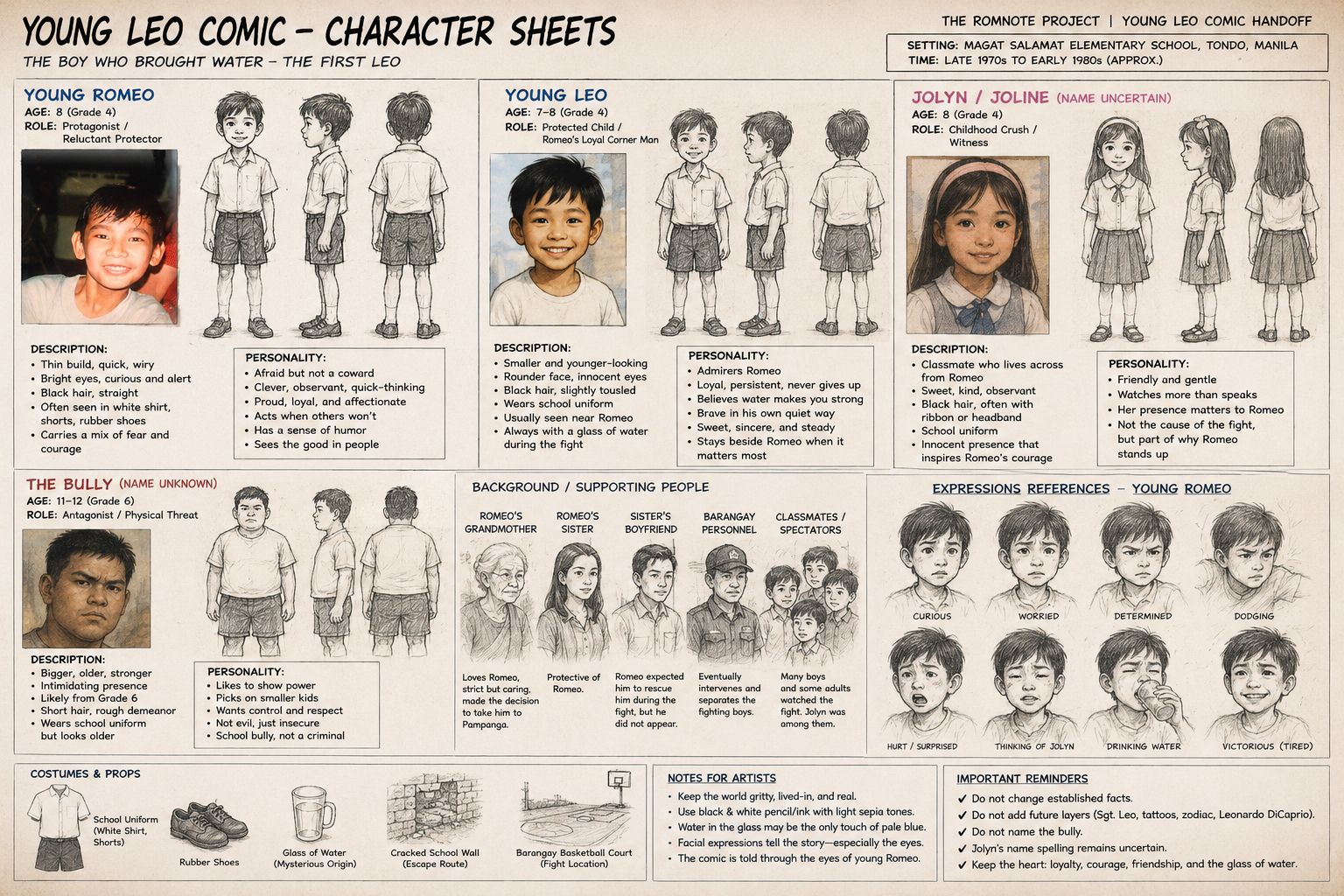
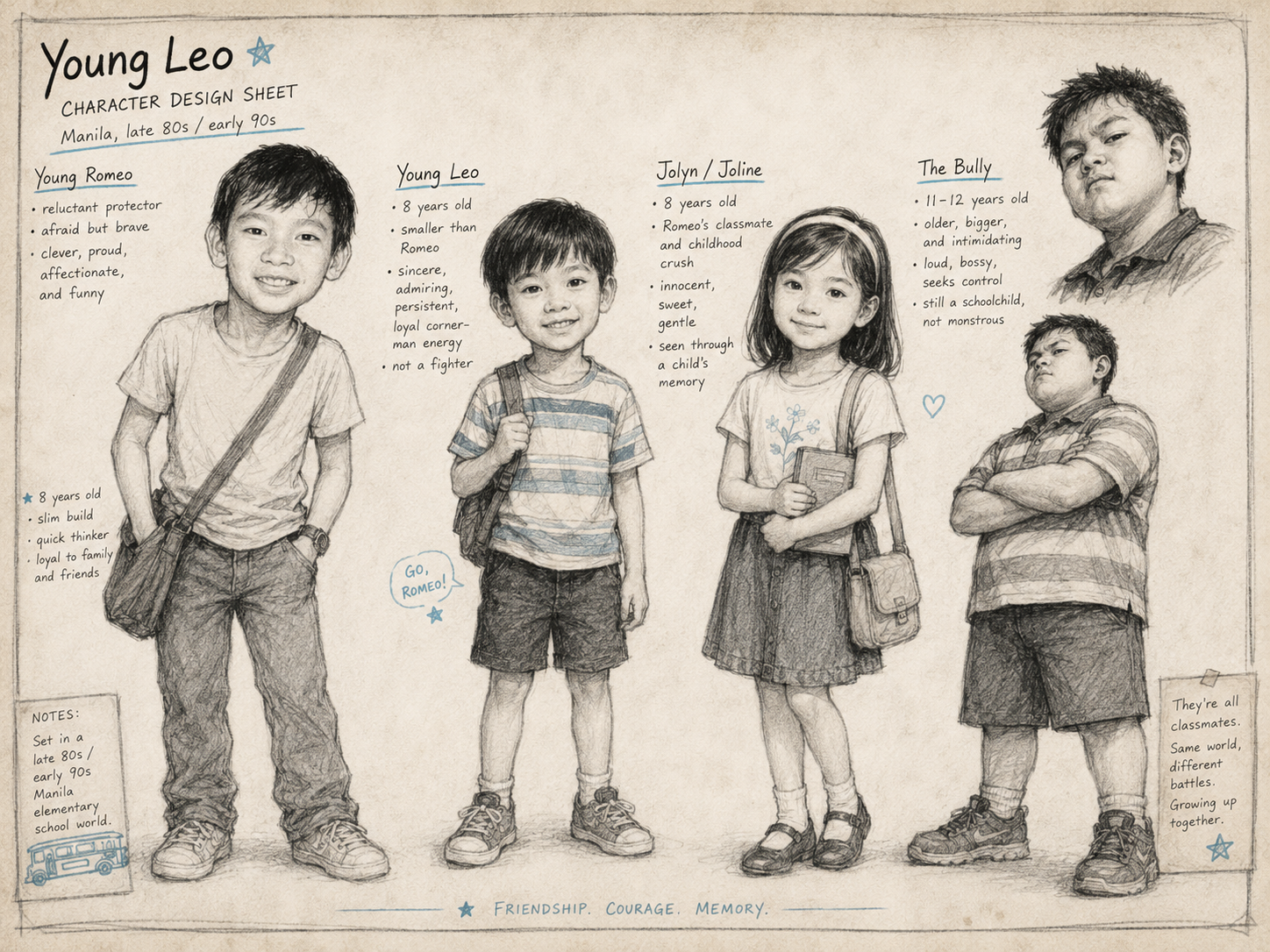
These Young Leo comic-prep sheets are preserved inside the readable page as visual references for the story’s childhood world, character relationships, and emotional tone.
Visual Archive Note
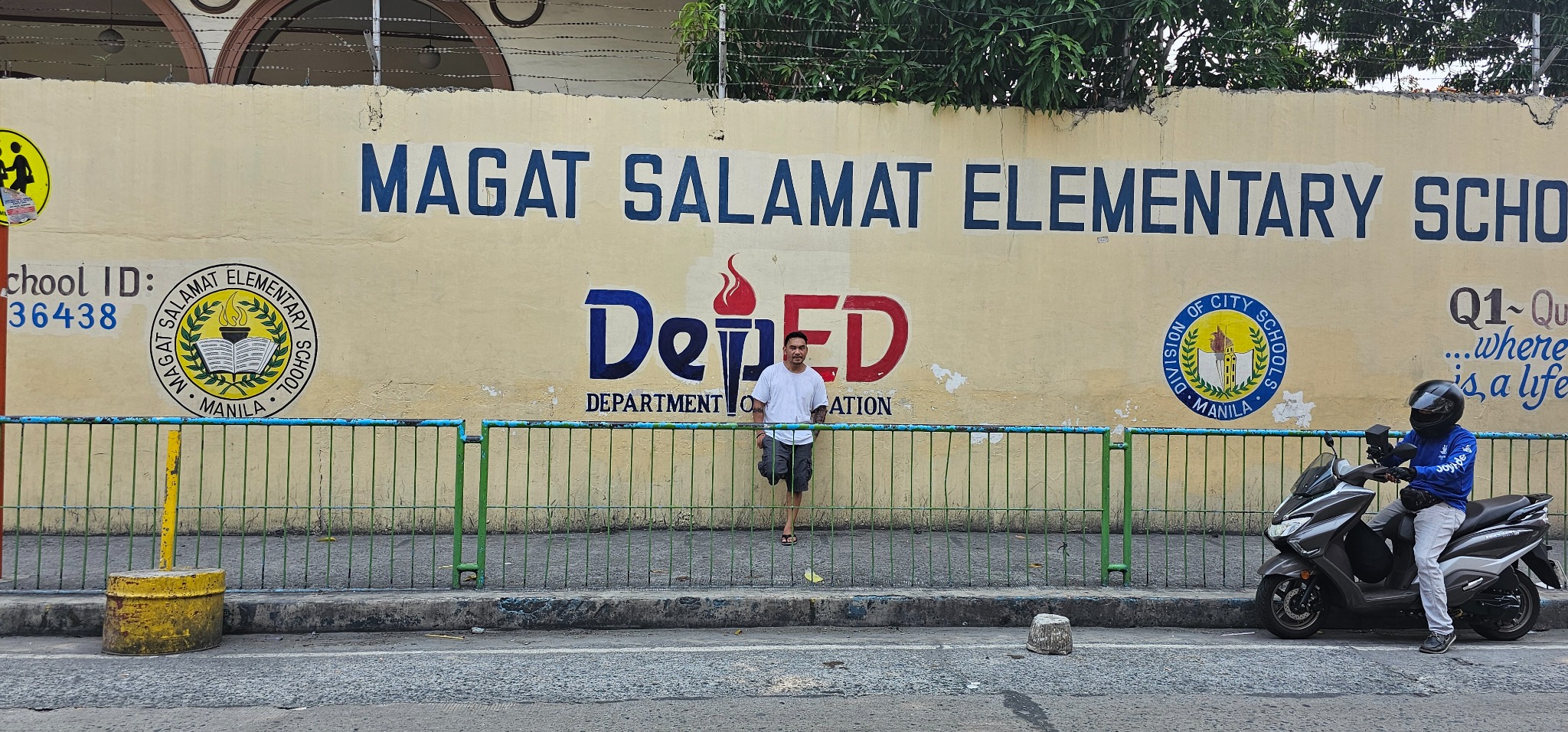
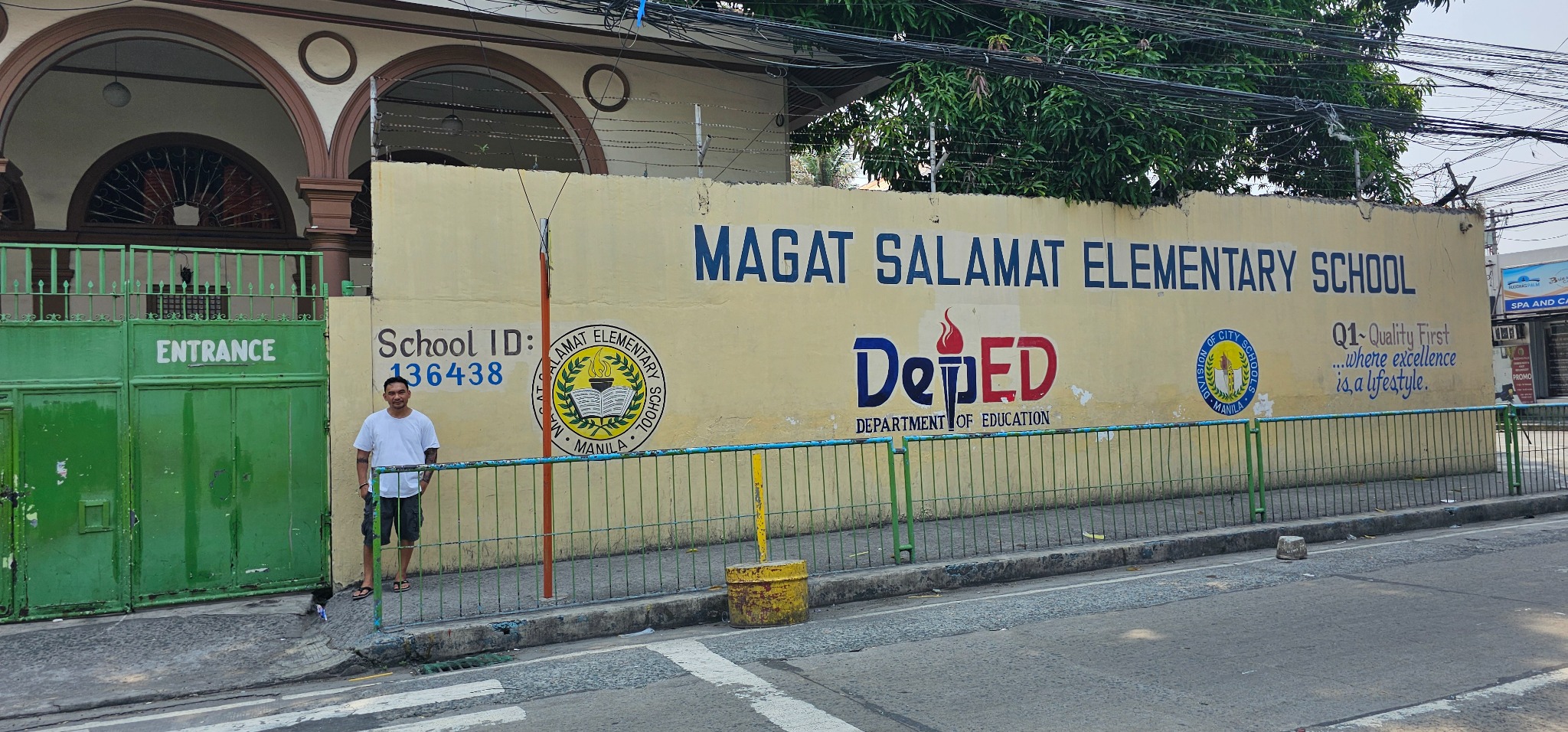
The first two images are interpretive character-design references created during the Young Leo comic drafting handoff. The final two images are real photographs from Romeo’s 2024 return to Magat Salamat Elementary School. They document the actual school and location connected to the story, while the childhood fight itself remains preserved through Romeo’s recollection.
Returning to the School
In 2024, I stood again outside Magat Salamat Elementary School in Manila. I was no longer the eight-year-old boy who once walked through its gates. I was a grown man looking at a wall, an entrance, and a school name that had carried an entire world I had not visited in decades. The building had aged. The paint had changed. The street was crowded with the movement of a city that never waits for anyone. Yet the moment I saw the school, one particular day returned with unusual clarity.
That school was connected to the house where I grew up, to people I would later lose, and to histories that would not reveal their meaning until much later in my life. At the time, however, none of that existed. I was simply a fourth-grade boy at lunchtime, surrounded by classmates, noise, sunlight, and the kind of bravery that usually appears before a child understands the price of it.
Luksong Baka
At lunch, the students gathered around the main square in the middle of the school, near the flagpole. Teachers organized sections and groups, but children always found space to turn order into play. My friends and I were playing luksong baka—“jump over the cow.” One child bent low while the others ran and jumped over. With each round, the child serving as the “cow” rose a little higher, until the game became nearly impossible and everyone laughed at the awkward attempts to clear the final jump.
Among the children playing was a girl named Jolyn—or Joline, as I remember the name. She lived across from my house and was my classmate. We were not close. At that age, the girls usually stayed with the girls and the boys stayed with the boys. I did not know anything serious about love. I only knew that she was a girl, she was cute, and I was very aware whenever she was nearby.
The game changed when an older boy, a sixth grader, entered our space. He was bigger than any of us and carried the confidence of someone who knew that size alone could silence a crowd. He began disturbing the game and harassing one of my classmates—a small boy named Leo. The girls told the bully to stop. The boys did nothing. The bully ignored the girls because he knew no one his size was challenging him.
The Sentence That Nearly Ended My Childhood
Then I decided to be brave. Or foolish. The difference is not always obvious when you are eight years old and a cute girl is watching.
I stepped forward and said something like, “Hey! Fight someone your own size!” It sounded heroic for approximately one second. Then the sixth grader turned toward me, and I understood that I had just volunteered to become the person his own size—at least in his opinion.
He looked ready to punch me out of existence. Before he could, the school bell rang. Every student had to return to the proper formation and go back to class. For a brief moment, I believed I had been saved by the bell.
“I had not been saved. I had only been given an appointment.”
Leo Becomes My Corner Man
After that threat, Leo attached himself to me for the rest of the day. I had defended him, and he suddenly treated me as though I were a champion who had accepted a title fight on his behalf. He followed me through the school like a small, loyal shadow. He encouraged me. He believed in me far more than I believed in myself.
One sentence remains clear in my memory, though he said it in Tagalog: “Romeo, you need to drink water. It makes you strong. You can beat this guy.” He kept offering water as if hydration were the secret military technology that would transform a frightened fourth grader into an unbeatable fighter.
The truth was that I was scared. There was a cracked section of the school wall where students sometimes climbed or jumped out. I knew I could escape. I could have slipped away before dismissal and avoided the fight entirely. Yet Leo’s presence kept me from panicking. He had begun the day as the child who needed protection, but by afternoon he was the one keeping me from running.
The Bahay Kubo
The last class of the day was art. I remember sitting in the art room, drawing or painting a bahay kubo, the traditional Filipino nipa hut. I can still draw that kind of house today with surprising clarity. Maybe the memory survived because it was the last ordinary thing I did before walking toward what felt like my own execution.
And what was Leo drawing? The same bahay kubo. He copied the same house as if he had decided, “Well, Romeo may be attending a funeral after school, so I might as well remain beside him until the end.” Even now, the image makes me laugh. He was not only my admirer and water coach. He had apparently become my artistic understudy too.
Choosing the Ground
While I waited for the final bell, my young mind formed a plan. The barangay hall was beside the school, and my older sister’s boyfriend was connected to the barangay as a tanod or local officer. I reasoned that if I moved the fight near the barangay basketball court, he—or one of the other adults—would see what was happening and stop it before I was seriously hurt.
It was not a plan to win. It was a plan to survive without looking like I had run away.
When school ended, I walked outside and waited near the entrance. The sky seemed to turn cloudy, though I do not know whether rain was truly coming or whether fear simply changed the color of the world around me. I saw the bully and worried that he would attack before I could even speak.
Instead, he looked around and said, in Tagalog, “Not here. Too many people.” Inside, I celebrated. This was exactly the opening my plan needed. Outside, trying to sound fearless, I answered, “Fine. Let’s go to the basketball court by the barangay so we have more space to fight.”
The words came out with far more confidence than I felt. The moment I heard myself say them, part of me regretted sounding so enthusiastic about the amount of space required for my own beating.
The Procession
The bully agreed, and we began walking toward the barangay. Leo walked beside me, still serving as my tiny coach. The students understood immediately what was happening. A crowd formed behind us and followed as though this were a championship event—Pacquiao versus Holyfield, except one fighter was a frightened fourth grader and the other was a sixth-grade bully.
Adults followed too. Looking back, I still wonder why no one stopped us before the fight began. Perhaps they did not understand. Perhaps they expected the barangay officers to intervene. Or perhaps the sight of two schoolboys marching toward a basketball court was simply too interesting for common sense to interrupt.
And Jolyn was there. Of course she was there. By then, retreat had become impossible in my young mind. My heart was telling me this might be the last day of my life, but at least the cute girl would see that I had stood up for someone.
The Fight
At the basketball court, the bully raised his arms. I raised mine too, pretending I knew what fighters were supposed to look like. I did not know how to fight. I only knew that I was scared, the crowd was chanting, Leo was near me, and the future brother-in-law who was supposed to rescue me was nowhere to be found.
The bully threw the first punch. I dodged it.
He threw another. I dodged again.
For a few seconds, I believed I had discovered the perfect strategy: keep moving until he became tired, then wait for an adult to stop everything. Unfortunately, I learned a terrible physical truth—dodging also makes the person dodging tired.
My legs slowed. My breathing changed. No rescue appeared. I realized that I would have to hit back.
I swung and caught him on one cheek. He stepped back. For one glorious instant, I had actually landed a punch on the bigger boy. Then he looked at me with even greater fury.
His fist came toward my face.
Remembered Thought While Falling
“Dear Jolyn, did you know you’re so cute?”
Then I hit the ground.
The Glass of Water
My cheek was bleeding slightly and beginning to swell. The bully was also trying to regain his footing after the exchange. The crowd remained loud. And through all of it, I heard Leo.
“Here—drink water!”
He came toward me holding a glass cup. To this day, I cannot explain where he found an actual glass while we were outside the school grounds and in the middle of a crowd. Perhaps someone nearby gave it to him. Perhaps he had been preparing for this moment all afternoon. In my memory, it simply appeared in his hands as though his only mission in life was to keep Romeo hydrated through disaster.
I drank the water. Then I stood up.
The fight resumed. I tried to land another punch and missed. He swung and missed. Soon both of us were throwing our arms carelessly, no longer resembling fighters at all—just two exhausted children swinging wildly while a crowd shouted around us.
That was finally when the barangay people intervened. They separated us, cleared the crowd from the area, and escorted both of us back home. My wonderful future brother-in-law never appeared during the part of the plan in which he was supposed to save me.
The Last Day
That fight became the last day I ever saw Leo.
When my grandmother learned what had happened, she went to the school, kept me from going back outside, and soon took me away to Pampanga. The adults believed I was becoming a basagulero—a troublemaker, a boy who was always getting into fights. The irony was that I had not started the fight because I enjoyed violence. I had spoken because a smaller child was being harassed, because the girls were the only ones objecting, and because Jolyn was watching.
I never saw Jolyn again either. There was no goodbye to her, no final conversation with Leo, and no chance to explain why I disappeared. One day I belonged to that school, that street, and that little circle of classmates. Then the chapter closed before I understood that it was ending.
The Pampanga Rehabilitation Program
My grandmother’s solution for preventing me from becoming a basagulero was to take me to the province, where my cousins lived. It sounded like discipline, safety, and a fresh start.
Almost immediately after I arrived, my uncle looked toward one of my cousins and said something like, “Tumbukan ne!”—essentially giving permission for us to fight.
I barely had time to say, “What?” before my cousin—who, in my childhood description, looked like a monkey—jumped me. We ended up in what I can only describe as a gorilla fight, supervised by his own father.
So the official family strategy for correcting a child accused of fighting was apparently to transport him to Pampanga and immediately enroll him in a cousin combat program. It was there that young Romeo began learning how to defend himself physically—not because he had gone looking for violence, but because violence had an inconvenient habit of finding him.
What the First Leo Left Behind
For years, this was simply a childhood story: the cute girl, the bully, the crowd, the failed rescue plan, the punch, the swollen cheek, and the mysterious glass of water. Only much later did the name Leo begin to reveal its deeper place in my life.
The first Leo was not the strongest child. He was the one who had needed help. Yet after I stood up for him, he stayed beside me. He could not fight the bully in my place, but he could follow me, encourage me, offer me water, and remind me that I was capable of standing again.
That distinction matters. Leo was never the captain of my body or the owner of my choices. Romeo chose the ground. Romeo faced the fear. Romeo threw the punch. Romeo fell. And when Romeo was down, Leo brought the water.
RomNote Interpretation of the First Leo
Decades later, one of the principles that would guide my reflections became “fight fire with water”—answering rage with patience, chaos with control, and destruction with peace. I cannot prove that the adult principle consciously grew from that childhood glass. Memory does not always reveal its architecture so neatly. But the connection is too meaningful for me to ignore.
Leo does not fight in Romeo’s place. Leo brings the water when Romeo falls. Romeo is the one who gets back up.
Love Before I Knew the Word
I was eight years old. I did not understand mature love. I knew only that Jolyn was a girl and that I thought she was cute. Yet affection had already become connected to courage in my young mind. Because she was watching, I wanted to become braver than I felt. Because Leo was being hurt, I wanted to become stronger than I was.
That day may have planted an early lesson: when I care about someone, I stand up. I endure. I protect. I do not run. That lesson contains something beautiful, but it also carries a warning. Love can inspire courage, but love should not require a person to absorb endless injury merely to prove that the love is real.
Jolyn awakened the bravery. Leo stayed when the bravery became costly. And young Romeo discovered that fear and courage can exist in the same body at the same time.
Epilogue: The Boy Who Never Left
I never saw the first Leo again. He may never have known what became of the boy he followed that day. He may not remember the fight, the bahay kubo, the crowd, or the glass he carried.
But some people remain in our lives without remaining in our sight. The small classmate who once needed protection became the first person to stand beside me after my courage had created a price I was afraid to pay. He offered no great speech. He had no power to stop the bully. He simply believed, brought water, and waited for me to rise.
Perhaps that is why the name survived.
The child disappeared from my life, but the role remained: the loyal presence at the edge of the fight, guarding against surrender, reminding Romeo that being knocked down is not the same as being finished.
Somewhere in the memory of Magat Salamat Elementary School, young Leo is still beside me—small, determined, and holding a glass of water that he somehow found when I needed it most.
Source & Citation
Category: Personal History / Childhood Memory / RomNote Journal
Recorded: Tuesday, June 17, 2026
Project: The RomNote Project
Author / Voice: Romeo Imbien Mesina
Assistant / Archive Support: Jarvis
Story Basis: Rewritten and expanded from Romeo’s spoken recollection of the Young Leo schoolyard story.