
My Therapy Session Needs Therapy.
An RNP Comic Relief Journal Entry
Based on the Telehealth Therapy Appointment of June 30, 2026, 3:00 PM
🎧 Audio Conversation
Listen to the RNP audio conversation for this comic-relief journal entry.
Conversation player is ready.
RNP Source Note
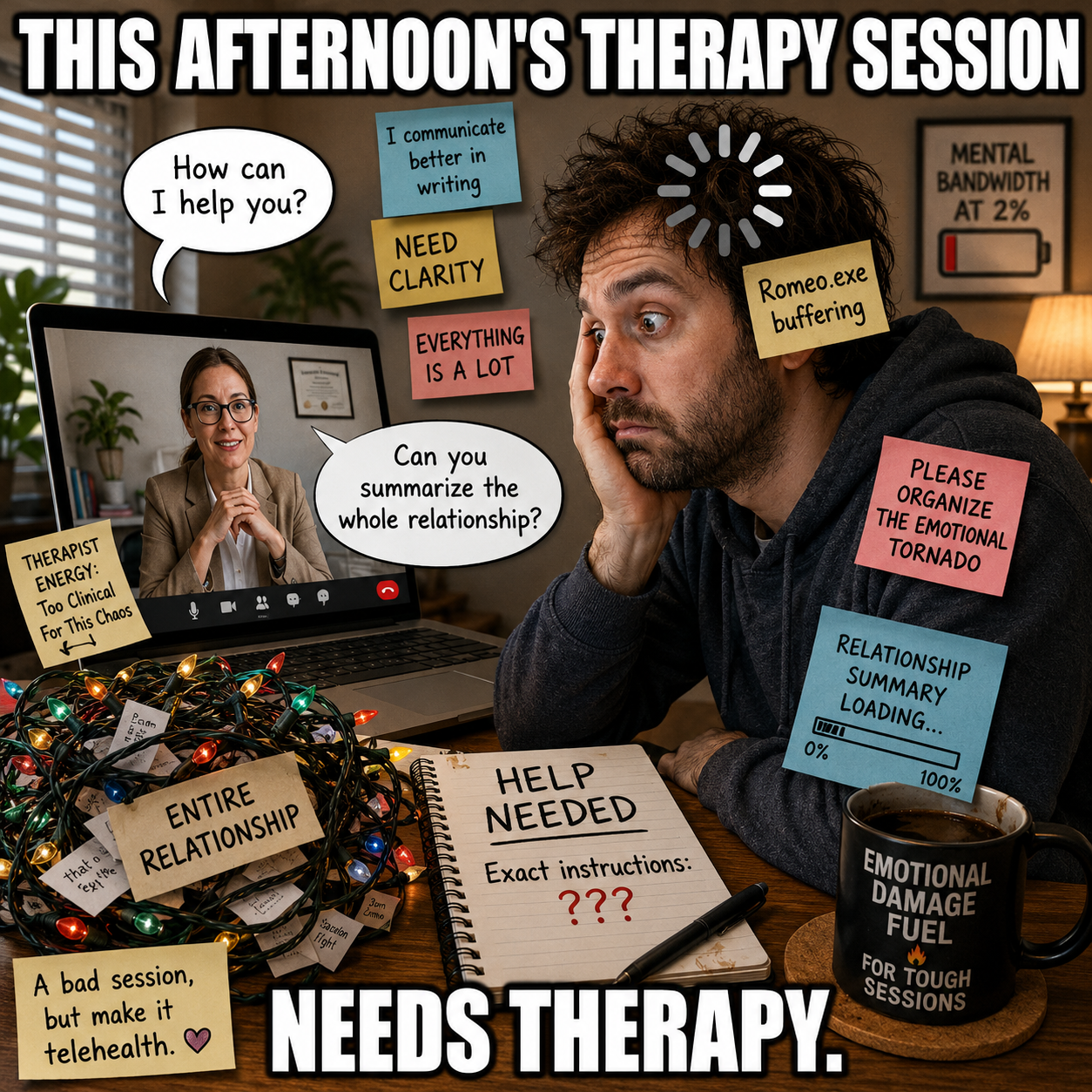
This comic-relief journal entry preserves Romeo’s June 30, 2026 telehealth therapy appointment reflection, especially the discovery that live emotional speech needs structure, patience, and sometimes a loading screen.
Journal Entry
A bad session does not mean therapy failed. Sometimes the session itself needs to lie down on the couch for a minute.
There are moments in life when a man seeks help.
There are also moments when the help arrives carrying a clipboard, asks one question, accidentally summons a boss fight, and leaves the man wondering whether the therapy session itself needs to book an emergency appointment.
This is one of those moments.
On Tuesday, June 30, 2026, at 3:00 PM, Romeo attended a telehealth therapy session with honest intentions. He did not enter the session looking for drama. He did not show up wearing emotional armor and shouting, "Let us unpack the entire archive of my life in forty-five minutes."
He showed up because he needed help.
Simple.
Human.
Reasonable.
He came into the appointment with relationship stress, confusion, emotional exhaustion, and the kind of complicated life situation that does not fit neatly into a two-sentence summary unless the summary is:
Everything is a lot, and I am trying not to fall apart.
Unfortunately, therapy sometimes begins with the most terrifying question known to emotionally tired people:
How can I help you?
This question sounds gentle on paper.
In real life, for someone whose thoughts are scattered across five emotional tabs, three unfinished downloads, and a frozen browser window named Childhood.exe, this question can feel like being handed a microphone at a press conference you did not know you were attending.
Romeo’s mind heard the question.
Romeo’s soul attempted to answer.
Romeo.exe began loading.
Then the system displayed:
Verbal Communication Buffering
Please wait while Romeo searches for the correct emotional file.
The Question That Started the Boss Fight
The problem was not that Romeo did not need help.
He did need help.
The problem was that he did not yet know how to explain the shape of the help he needed.
That was the whole reason he was there.
Asking him to explain exactly how he needed help was like asking someone who is lost in the woods to provide a GPS coordinate, a map legend, and a five-year forest management plan.
Sir, if I had the map, I would not be talking to the trees.
Romeo was not refusing help.
Romeo was looking for help finding the shape of the help.
But in the session, it felt like the process moved too fast. It felt like the therapist wanted a summary of an entire relationship, an entire emotional history, and an entire human being’s complicated heart in a clean little package.
Please summarize the relationship.
Please identify the stressor.
Please explain how I can help.
Please organize the emotional tornado.
Please do this while speaking live.
Please do this without turning into a confused Windows update.
And Romeo tried.
He really did.
Romeo.exe Has Entered Verbal Mode
But verbal communication is different from writing.
Writing gives Romeo room.
Writing lets the thoughts line up.
Writing allows the emotional furniture to be moved one piece at a time.
Speaking, especially under pressure, is a different animal. Speaking requires the brain to feel, remember, organize, explain, filter, and protect itself all at once.
That is not a conversation.
That is emotional CrossFit.
And Romeo had apparently arrived on leg day.
The Clipboard Needed Boundaries
The session became tense because Romeo felt misunderstood. It did not feel like someone was sitting with him inside the complexity. It felt like someone was standing outside the complexity with a clipboard saying:
Interesting. Have you considered that this is not working?
Which may have been meant as a clinical observation.
But what Romeo heard was closer to:
Your life appears to be on fire. Have you considered not having a life that is on fire?
Thank you, Captain Obvious, Defender of the Already Known.
Romeo already knew things were difficult.
He did not need the speed-run version of clarity.
He needed someone to slow the room down.
He needed help organizing the problem before being handed a conclusion.
He needed structure.
He needed patience.
He needed the therapeutic equivalent of:
Let’s take this one piece at a time.
Instead, the session felt like it jumped too quickly into the conclusion that if the relationship stressor is the relationship, then maybe the relationship is not going to work.
And maybe that kind of statement has a place.
Maybe there is a time when a therapist needs to be direct.
But timing matters.
Delivery matters.
Trust matters.
Human warmth matters.
You cannot ask someone to place their heart on the table and then immediately begin labeling the organs.
Sometimes the first job is not to diagnose.
Sometimes the first job is to make the person feel safe enough to keep talking.
Romeo did not feel fully heard.
He felt tense.
He felt judged.
He felt like the whole emotional archive was being compressed into a ZIP file labeled:
Relationship Problem Final Version FINAL final v7.docx
And of course, the ZIP file failed.
Because this was not just a relationship summary.
This was a life.
This was love, fear, loyalty, boundaries, hope, exhaustion, fatherhood, immigration stress, history, faith, confusion, and the ongoing mission not to disappear inside other people’s chaos.
That does not fit into a quick intake answer.
That needs room.
That needs time.
That needs a therapist who understands that some people do not speak their deepest truth in perfect sentences on command.
Some people need to write it first.
Some people need to circle the truth three times before they can name it.
Some people need the emotional runway cleared before the plane can land.
The Writing System Works
Romeo is one of those people.
And that is not weakness.
That is simply his communication system.
He can write.
He can document.
He can reflect.
He can take emotional damage and turn it into a structured archive with section headings, timestamps, moral lessons, spiritual implications, and probably a website update if left unsupervised for too long.
But speaking live?
Speaking live is different.
Speaking live is the wild west.
Speaking live is Romeo trying to carry a full filing cabinet through a revolving door.
So when the therapist asked how she could help, Romeo did not have a polished answer.
He had the honest one.
I do not know how you can help me. I know I need help. I was hoping you could help me figure that out.
That is a valid answer.
In fact, that may be one of the most honest answers a person can bring into therapy.
Because therapy is not supposed to require the client to arrive with a complete treatment plan, a PowerPoint presentation, and an emotionally optimized mission statement.
Sometimes the starting point is:
I am confused.
I am overwhelmed.
I know something hurts.
I do not know what to do with it yet.
Please help me sort it out.
That should be enough to begin.
But this session did not feel like that.
This session felt like Romeo brought tangled Christmas lights and the response was:
Have you considered that the lights are tangled?
Yes.
Thank you.
That is why I brought them.
Not Destroyed. Just Disappointed.
By the end of it, Romeo was disappointed.
Not destroyed.
Not hopeless.
Not shattered.
Just disappointed.
The kind of disappointment that makes a man sit afterward and think:
Maybe I could have said it better.
Maybe I explained it wrong.
Maybe I should have prepared more.
Maybe it was my fault.
But then another truth appeared.
No.
It was not all Romeo’s fault.
He was trying to communicate in a format that is not his strongest format, about a subject that is emotionally loaded, with someone he had not yet built deep trust with, under the pressure of a limited appointment window.
That is not failure.
That is a mismatch of method, moment, and need.
And from that mismatch, Romeo discovered something useful:
Next time, he may need written notes.
Next time, he may need to say at the beginning:
I communicate better in writing. When I speak about emotional things, I can get tangled. I may need help slowing the conversation down and organizing the pieces before jumping to conclusions.
That is not an excuse.
That is a strategy.
That is the emotional version of bringing a map, a flashlight, and maybe snacks.
Because apparently therapy can also become a survival mission.
After the session, Romeo did what he often does when life throws him into emotional fog.
He documented it.
He wrote it down.
He turned the confusion into words.
And once it became words, it became less powerful.
It was still annoying.
Still disappointing.
Still one of those experiences where the mind keeps replaying the scene like a bad customer service call.
But it was no longer shapeless.
The Punchline Arrives Wearing a Name Tag
And then came the punchline.
At some point, after eating, breathing, calming down, and looking back at the wreckage of the appointment, Romeo reached the only reasonable conclusion:
My therapy session needs therapy.
That sentence carried the whole experience.
It did not attack anyone.
It did not pretend everything was fine.
It simply took the awkwardness, the disappointment, the emotional tension, and the failed communication moment, and wrapped it in comedy.
The session was supposed to help Romeo unpack things.
Instead, the session walked in carrying its own emotional baggage, sat on the couch, and said:
So how does that make me feel?
The therapy session needed a therapist.
The intake questions needed a nap.
The conclusion needed to slow down.
The clipboard needed boundaries.
The phrase “How can I help you?” needed a support group.
And Romeo needed dinner.
Why This Belongs in RNP
This is why comedy matters inside RNP.
Not everything has to become a heavy chapter.
Not every painful moment needs violins, storm clouds, and a slow-motion walk through the rain.
Sometimes healing looks like laughing at the absurdity.
Sometimes the emotional damage does not need a monument.
Sometimes it needs googly eyes.
Sometimes the wind does not need to become a tornado.
Sometimes you capture the wind, put it into a helium tank, fill a balloon, draw a funny face on it, and let it float until it pops back up.
That is what this entry is.
A balloon.
A funny-faced little balloon carrying one strange truth:
The therapy session did not go well, but Romeo still got something from it.
He learned that he communicates better in writing.
He learned that he needs structure before conclusions.
He learned that not every helper will be the right helper.
He learned that needing help does not mean knowing exactly how to ask for it.
He learned that a bad session does not mean he failed therapy.
It may simply mean that the session itself needs to lie down on the couch for a minute.
And honestly, fair enough.
Because some days, even therapy needs therapy.
Closing Reflection
I went to therapy looking for clarity.
Instead, I discovered that my thoughts need a loading screen, my verbal communication needs a warm-up lap, and my therapy session may need its own therapist.
But I am okay.
I ate.
I laughed.
I documented it.
And for once, instead of turning pain into another sad archive, I turned it into a balloon with a funny face.
Let it float.
Let it wobble.
Let it pop when it is ready.
RNP does not always have to bleed.
Sometimes RNP gets to laugh.
Source & Citation
Category: RNP Comic Relief Journal Entry / Therapy Reflection / Communication Humor
Recorded Date: Tuesday, June 30, 2026 • 3:00 PM • America/New_York
Project: The RomNote Project
Author / Voice: Romeo Imbien Mesina
Archive Support: Jarvis
Source Note: Created from Romeo’s June 30, 2026 therapy-session reflection and RNP comic relief documentation.