
Love, Sacrifice, and Accountability
A RomNote reflection defining the boundaries between enduring love, self-destructive sacrifice, forgiveness, and the accountability required to rebuild trust.
🎧 Audio Conversation
Listen to a two-host conversation exploring devotion, sacrifice, personal responsibility, consequences, honest self-examination, and the accountability required by mature love.
Conversation player is ready.
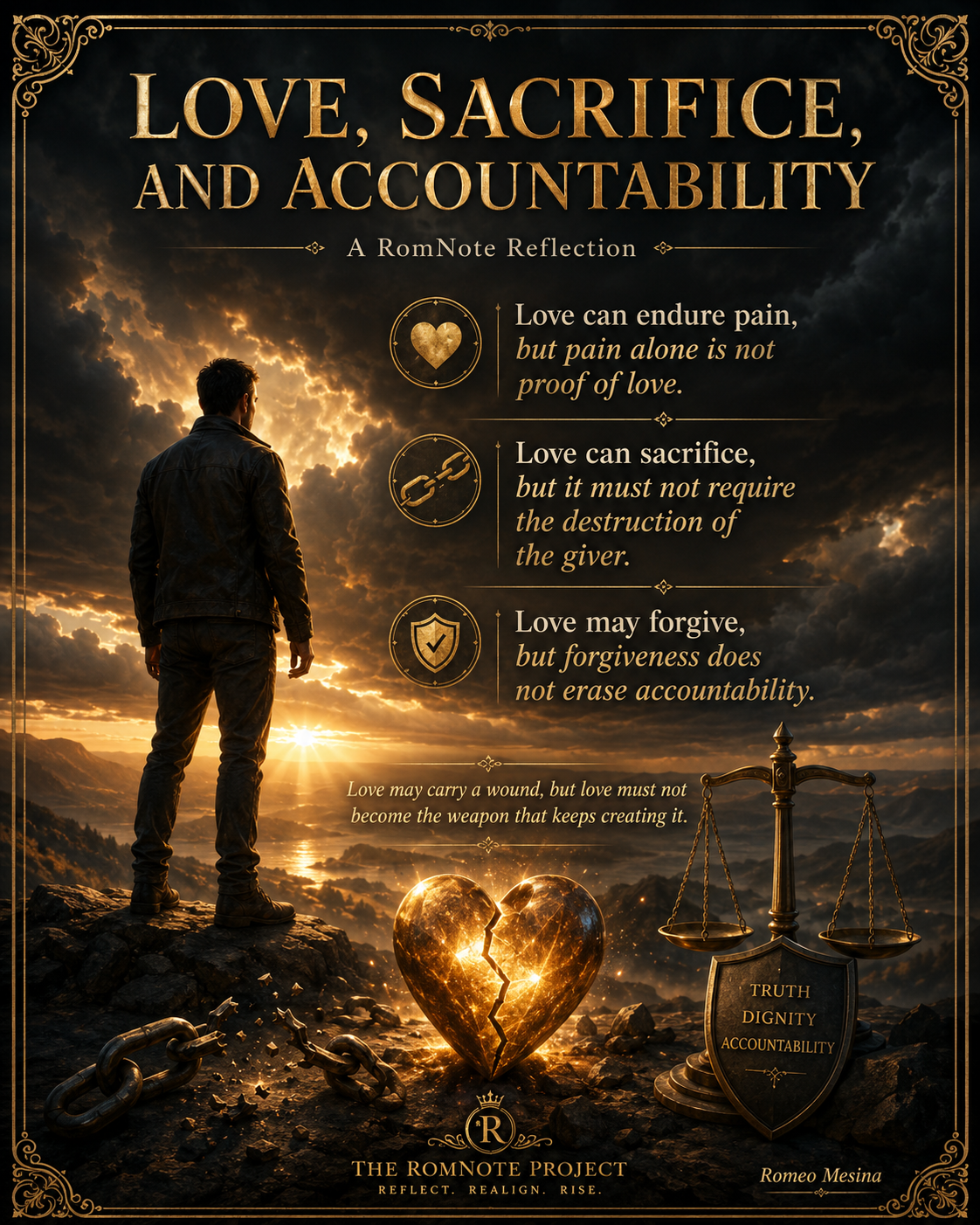
The Boundary These Words Protect
Love can endure pain, but pain alone is not proof of love.
Love can sacrifice, but it must not require the destruction of the giver.
Love may forgive, but forgiveness does not erase accountability.
The Meaning Behind the Words
These three lines draw an important boundary around love. They do not make love smaller; they protect it from being confused with suffering, self-erasure, or the absence of consequences. Love may be strong enough to survive pain, but pain by itself cannot prove that love is present. A person can hurt deeply because of attachment, fear, loneliness, habit, or hope. Endurance may reveal strength, but it does not automatically make every painful situation loving.
True love can sacrifice. It can give time, comfort, money, energy, patience, and even personal dreams for the good of another. Yet sacrifice becomes distorted when the giver must be emptied, silenced, or broken in order for the relationship to continue. Love should call a person toward generosity, not toward disappearance. The giver remains a human being with dignity, limits, needs, and a soul that also deserves care.
Forgiveness is one of love's greatest expressions, but forgiveness is not the same as pretending that nothing happened. It may release hatred, revenge, or the desire to punish, while still requiring honesty, changed behavior, boundaries, restitution, or consequences. Without accountability, forgiveness can be misused as permission to repeat the wound. Love can offer mercy and still say, 'This must not continue.'
A Deeper Reflection
There is a dangerous belief that the amount of pain a person accepts proves the depth of his love. But love is not measured by how much damage someone can survive. A relationship does not become sacred merely because one person keeps enduring what hurts. Sometimes the most loving act is not to endure another wound, but to speak truth clearly enough that both people must face what the pain is doing.
The same is true of sacrifice. Giving can be beautiful when it is chosen freely and received with gratitude, respect, and care. But when sacrifice is expected without limit, the giver slowly becomes a resource rather than a person. His loyalty is noticed, but his exhaustion is ignored. His provisions are accepted, but his heart becomes invisible. Love must never require someone to prove devotion by participating in his own destruction.
Accountability preserves the meaning of forgiveness. It asks the person who caused harm to recognize the wound, take responsibility, and help create safety for the future. This does not weaken mercy. It gives mercy direction. Forgiveness can open the door, but accountability determines whether trust can walk through it again.
RomNote Conclusion
Love is capable of enduring, sacrificing, and forgiving. But each of those virtues must remain joined to truth. Endurance without truth becomes suffering without purpose. Sacrifice without dignity becomes self-destruction. Forgiveness without accountability becomes permission. Love is strongest not when it ignores pain, but when it faces pain honestly and refuses to let either the wounded or the one who caused the wound remain unchanged.
Love may carry a wound, but love must not become the weapon that keeps creating it.
Source & Citation
Category: Personal Quote / Love Reflection / Accountability
Recorded: Wednesday, June 10, 2026 — America/New_York
Project: The RomNote Project
Author / Voice: Romeo Imbien Mesina
Archive Support: Jarvis
Source: Content preserved from the uploaded Word document.