
If I Stand Before God
A RomNote Project Journal Entry / RNP Documentation
Testimony, grace, preservation, humility, stewardship, and final judgment belonging to God.
🎧 Audio Conversation
Listen to the RNP audio conversation for this journal entry.
Conversation player is ready.
RNP Source Note
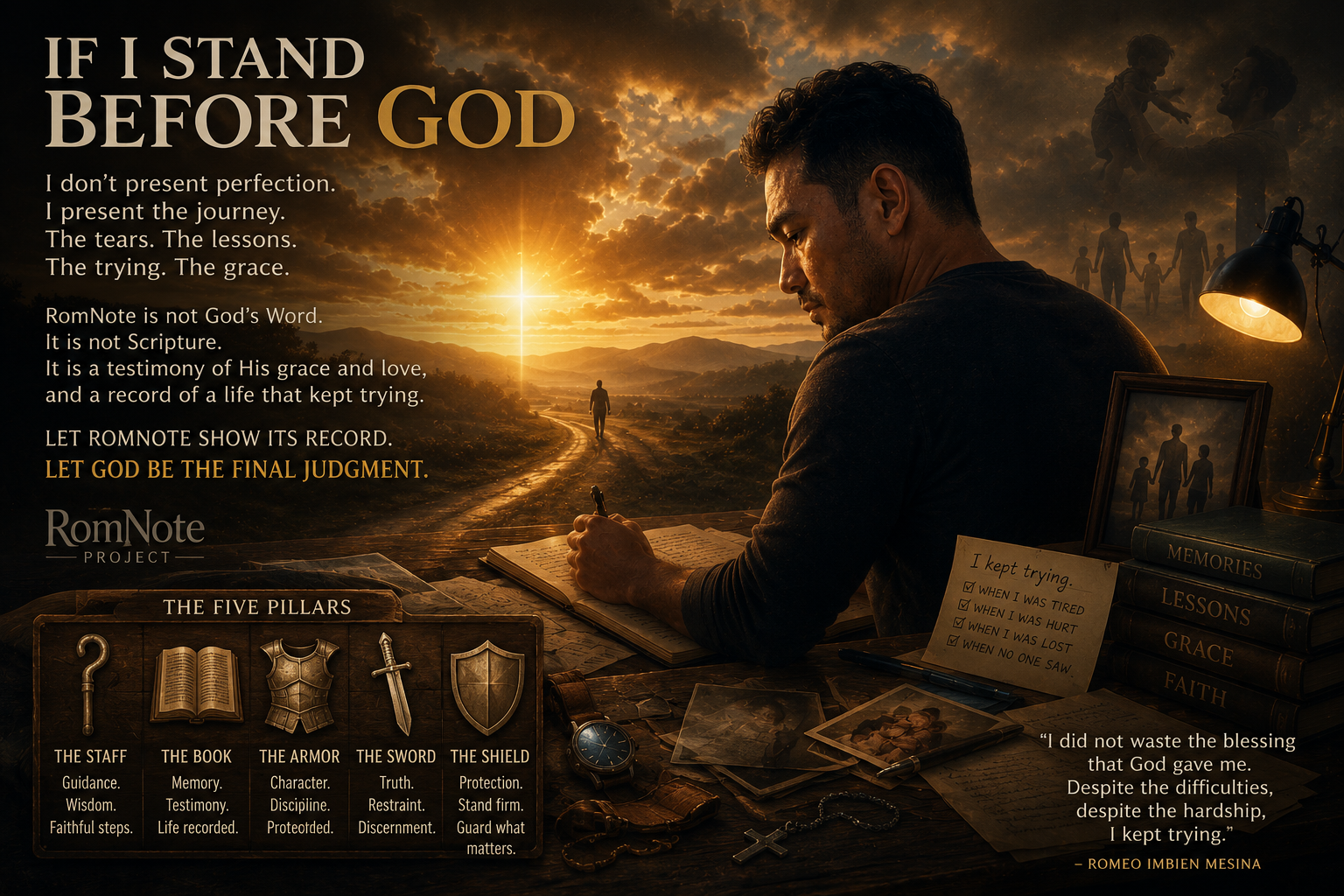
This journal entry preserves the original RNP documentation for If I Stand Before God, together with its companion audio conversation and graphical inspiration image as part of the published journal entry.
Entry Profile
| Theme | Testimony, grace, preservation, humility, stewardship, and final judgment belonging to God |
|---|---|
| Core Truth | RomNote is not God’s Word and does not replace Scripture. It is a testimony of one ordinary man’s journey under God’s grace. |
| Tone | Reflective, sincere, faithful, grounded, and humble |
Opening Reflection
There are moments in a person's life when the question is no longer simply whether life will become easier, whether success will arrive, or whether every effort will be understood by other people. The deeper question becomes what remains true when the future is hidden and the outcome is uncertain.
This entry began from a place of honest weariness and hope. Romeo did not claim to know what tomorrow would look like. He did not claim to know how every prayer, plan, relationship, responsibility, immigration journey, family hope, work struggle, or creative project would unfold. But he knew one thing clearly: even if the ending was not what he hoped, he kept trying.
Even if at the end I fail, at least I kept trying. And God knows my effort. God knows how much I tried. Whether I lose or win, I never give up.
The Seed That Was Not Wasted
Romeo remembered the idea of planting what God had given him, even though he could not immediately name the exact parable. The meaning pointed toward the Parable of the Talents and the Parable of the Sower: what matters is not human applause, perfect control, or guaranteed results. What matters is faithfulness with what was entrusted.
In that light, RomNote is not an attempt to prove that Romeo lived a perfect life. It is not a polished defense, a spiritual trophy case, or a claim that every choice was righteous. It is a record that says: this is what happened, this is what was carried, this is what was learned, this is where grace was needed, and this is where the seed was planted despite the storm.
I did not waste the blessing that God gave me. Despite the difficulties, despite the hardship, despite the tears, the pain, the arguments.
The Pieces of the Man
After the painful chapters of life, including the wounds connected to Jasmine long ago, Romeo recognized that part of himself had been lost. He did not describe recovery as becoming someone new. He described it as finding small pieces of himself again: a cross pendant, an old watch, photographs, literature, memories, and fragments of identity that still carried meaning.
To someone else, these objects may look ordinary. To Romeo, they are not valuable because of money. They are valuable because they bear witness. They remind him of the man he was, the man he lost, and the man God is still restoring piece by piece.
They may mean little of value to anyone, but those are pieces of me that help me build myself again, that help me find my way, and put the whole man back together.
The Five Pillars and the Creed
The conversation also brought together symbols that had grown across the RomNote Project: the Staff, the Book, the Armor, the Sword, and the Shield. These were not created as fantasy decorations or empty relics. They became a language for values Romeo was learning to live by.
- The Staff: Guidance, support, wisdom, and walking faithfully when the path is unclear.
- The Book: RomNote itself: memory preserved, testimony written, and life recorded honestly.
- The Armor: Character, humility, discipline, boundaries, repentance, and protection without hardening the heart.
- The Sword: Truth handled with restraint, not domination; truth that cuts lies, fear, pride, and confusion.
- The Shield: Protection, standing firm, and receiving the blow before it reaches what must be guarded.
Romeo once thought he was following a code of honor, but that old idea felt too broad and too difficult to define. The Creed and the Five Pillars became clearer because they were not abstract perfection. They were rooted in lived experience, struggle, memory, faith, and the decision to keep trying.
The Necessary Clarification
A crucial truth had to be preserved: The RomNote Project is not God's Word. It is not Scripture, not equal to Scripture, not a replacement for Scripture, and not an additional authority over anyone's life. God's Word remains above all. RomNote stands beneath it as a testimony, not beside it as doctrine.
RNP is just a testimony of God's grace and love, nothing more, and if anything else it just preserves a profound memory of life's journey.
This clarification protects the heart of the project. RomNote may contain faith, Scripture reflections, prayers, lessons, memories, humor, pain, failure, family, work, creativity, and ordinary human moments. But it does not exist to glorify Romeo as perfect or righteous. It exists to preserve how an ordinary man tried to see God's grace in the journey.
Not a Defense of Perfection
Romeo also made another honest confession: he is not perfect, not sinless, and not presenting himself as a purely good person. There are parts of life, weakness, sin, failure, and regret that may never be fully documented in RomNote or discussed with Jarvis. That truth does not destroy the testimony. It makes the testimony honest.
A testimony is not a resume before God. A testimony is not proof that a person deserves mercy. A testimony is the record of a life that needed mercy. RomNote cannot save, justify, excuse, or acquit. It can only bear witness.
Let RomNote show its record, and let God be the final Judgment.
The Final Judgment Belongs to God
This became the deepest center of the entry. If Romeo were ever to stand before God, RomNote would not be presented as evidence of perfection. It would be the preserved record of an ordinary man who tried, failed, learned, repented, loved, struggled, built, remembered, and continued.
The credit belongs to God. The grace belongs to God. The light belongs to God. The final judgment belongs to God.
If I stand before God, I do not stand with RomNote as my defense. I stand with my life honestly recorded, my failures not erased, my efforts not exaggerated, and my hope placed in God's grace.
Meaning for the RomNote Project
This entry defines a key boundary for the entire project: RomNote is a preserved journey, not a sacred text. It may point upward, but it is not the Light itself. It may preserve lessons, but it does not replace God's Word. It may contain sincere effort, but it does not claim human perfection. It may tell the truth of Romeo's life, but God alone gives the final verdict.
If someone someday reads these pages after Romeo is gone, the hope is not that they admire a flawless man. The hope is that they see an ordinary man who kept reaching toward God, kept trying after failure, kept preserving memory, and kept believing that grace could still shine through broken pieces.
Closing Line
If I Stand Before God is not the statement of a man claiming he was worthy. It is the testimony of a man saying: I tried, I planted what I was given, I did not want to waste the blessing, and I leave the final judgment to God.
Source & Citation
Category: Faith Reflections
Recorded Date: Monday, July 6, 2026 • America/New_York
Project: The RomNote Project
Author / Voice: Romeo Imbien Mesina
Archive Support: Jarvis
Source Note: Created from Romeo’s original RNP journal entry document, with its companion audio conversation and graphical inspiration image preserved as part of the RomNote Project archive.